June 2025

Tactical Operating Environment

Image

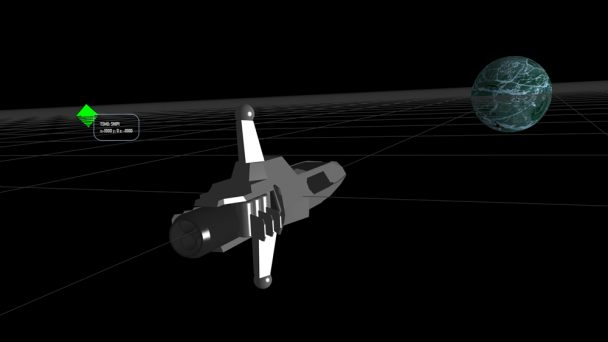
The Tactical Operating Environment (TOE) is the area of space surrounding the vessel that requires active management, due to possible navigational hazards or tactical threats. The TOE is defined by the range of tactical sensors, which locate and track non-mapped objects.

Depending on environmental conditions, the TOE extends to a radius of approximately 15 million kilometres.

Maintaining the TOE is the primary task of the vessel’s tactical team. This includes detection and tracking of unmapped objects around the vessel and if necessary developing firing solutions to any object deemed a threat to the vessel’s safety.

TOE Grid

The TOE grid (example top right) represents the vessel’s operating environment. It displays all mapped astronomical objects such as stars, planets, moons and other major bodies, as well as any mapped man-made objects such as space-stations.

The TOE grid also displays any other objects detected by sensors and deemed to be of significance to the vessel’s operation (see TSMOs below).

The grid is oriented to the orbital plane of the star system currently being navigated.

TSMOs

Tactically Significant or Maneuvering Objects (TSMOs, pronounced sumo) are un-mapped objects detected in the vessel’s operating environment that are of tactical significance.

All maneuvering objects – objects capable of altering their own course - are of tactical significance because it is assumed that a maneuvering object is of artificial construction and therefore a vessel of some kind. Naturally occurring objects that are capable of maneuvering are extremely rare.

TSMOs are detected by EMDAR (see below) and designated as a 'track' (tracked contact) if considered significant. Once tracked, the TSMO is displayed on the TOE grid for as long as detection is maintained (or if the TSMO is undesignated).

Fixed objects or those with defined movement (such as an orbit) may also be of tactical significance either because they may represent a possible threat - such as a weapons or sensor platform (in the case of a satellite or unmapped space station) - or because they may provide cover from detection.

Detection

The goal of tactical sensor systems is to detect a threat TSMO before it can achieve counter-detection, without giving away the location of the vessel in the process.

Combat Overview

EMDAR

Electro-Magnetic Direction and Ranging (EMDAR) is a passive sensor technology that detects EM emissions. The system is passive because it detects EM emitted by another vessel and calculates likely distance based on dispersal patterns. This is unlike an active sensor system that emits EM to bounce off a target, which is detected and analysed.

The advantage of the passive system is that it does not provide any EM emission for an opposing vessel to detect. The disadvantage is that passive systems can only achieve relatively weak readings, sometimes difficult to distinguish from background radiation. Dispersal patterns also become increasingly less predictable over distance, making range estimations less certain. 

The EMDAR detection process is therefore as much an art as it is a science. It requires an operator to spot patterns across multiple windows and make accurate estimates as to whether that pattern is a vessel (TSMO). If it is, then estimates as to range, heading and speed will be needed to help the commanding officer make tactical decisions.

More on EMDAR

Contacts

Broadband EMDAR can detect EM from anywhere around the vessel. If EM is detected, the EMDAR crew will declare a contact to the bridge along with whatever information they can provide such as heading, range, maneuvering patterns, etc.

The contact will appear on the Contact Board along with range and bearing to its last identified location. This location is a point in space that represents where the crew thinks the contact is likely to be, which cannot be used to track the contact or target weapons. 

Additional contacts will be added to the board over time, creating a pattern which indicates the contact's course.

Tracking

The crew will then work to refine the contact's suspected location until they believe they are close enough to attempt to track the contact using narrowband EMDAR.

Narrowband EMDAR provides greater detail from EM detections but only cover a narrow area of space. The improved EM analysis possible allows sensors to maintain contact with the contact as it moves, providing continuous updates on the contact's actual location.

If trained on an area of space that contains a contact the narrowband sensors will begin to track the contact, which is now referred to as a tracked contact (or "track").

Targeting

Once a TSMO's location is being tracked, it can be targeted by weapons systems.

Firing Solutions

A firing solution consists of information necessary to guide a torpedo to a contact if the need arises. This includes the TSMO’s bearing and its estimated speed and heading, as well as a definition of the search area the torpedo will use once it goes active.

This data only becomes a firing solution when the estimates are considered accurate enough to ensure a reasonable chance of a successful hit. This is determined by factors such as the strength of the EMDAR detection profile, range and the relative speed of the target and vessel.

More on Firing Solutions

Combat Overview

Image

Endeavour’s mission is one of exploration and discovery. In an unknown and distant environment however, the vessel must be able to defend itself if needed. There are already known threats to the ISDC’s mission from other terrestrial deep space programs and potentially other alien species. Even under the best circumstances, first contact in some completely new language risks misunderstandings that might escalate to conflict.

In the vastness of space, the ability to detect and counteract a potential threat before it can inflict harm is vital. This can be achieved with asynchronous tactical capabilities: the ability to track without being detected or to deliver combat payloads while outside the weapons range of the threat.  Ideally, both.

Asynchronous Detection

Tactical sensors with the longest possible range might allow detection of a threat before counter-detection can be made, but this requires the use of passive sensor systems. Passive systems simply ‘watch’ space looking for emissions across the electromagnetic (EM spectrum). They interpret whatever emissions reach their detection pods and so their use does not give away the scanning vessel’s position.  

Active sensors systems use directed or broadcast EM or energy emissions whose interactions with objects in space are detectable. Active sensor systems make detection much easier and accurate but conversely require easily detectable emissions to function.

Prosecution

A vessel operating with the advantage of asynchronous detection needs weapons systems with sufficient range to prosecute that advantage. Given the capabilities of tactical sensor systems this may be in the range of hundreds of thousands of kilometers.

Directed energy weapons are the staple of science fiction and are increasingly deployed terrestrially, but neither detection or targeting systems can support accurate firing over distances in space. Passive sensors are not accurate enough for targeting except within visual range (a range of just thousands of kilometers). Ranging shots might assist with refining target location but the first shot would immediately identify the exact location of the firing vessel, completely reversing the tactical advantage.

Even with accurate targeting, the smallest error in the angle of fire is magnified by distance. Over a relatively short range of 100,000KM a variance of just 0.0006° in firing angle would miss the target by an entire kilometer. Targeting and sensor technology – current or in development - does not provide anything close to the capabilities needed for the use of directed energy as the vessel’s primary weapons system.

Guided Weapons

Weapons which can be guided close to their target and then use their own active sensor systems to home in on the target can deliver prosecution capabilities at required ranges. In the naval tradition the ISDC refers to these self-guided weapons as torpedoes.

Aside from a brief burst of energy at launch, self-guided weapons can maneuver themselves towards a target, so their track cannot be used to directly trace their source. Torpedoes will retain contact with the vessel during their early track, using data from the launch vessel’s more powerful passive sensors. The torpedo need only engage its own active sensor systems when relatively close to the target, where even though detectable, the torpedo’s small physical profile, speed and close range will be challenge to counter.

Combat Cadence

It is unknown what combat operations in space will actually look like. Simulations will begin to provide some idea, but given how little is known about the combat capabilities of species yet to be contacted, only mission experience will tell.

Combat is unlikely to resemble the battles depicted in science-fiction, however. Vessels blazing away at each other from within easy visual range is an unlikely tactical outcome. Even the theoretical use of defensive shielding technology (currently unknown to the ISDC) doesn’t alter the fact that a vessel would still begin inflicting damage on another as soon as it was within weapons range, rather than waiting for an (admittedly more telegenic) close-range battle.

Combat operations in space are therefore expected to occur at extreme range, relying heavily on asynchronous detection. Even if the target manages to detect its attacker, maintaining range gives either a greater chance to slip from detection and make another attempt at gaining tactical advantage.

Invisibility will be the most effective armour in space.

Not all combatants are expected to use the same weapons systems. Vessels which rely on directed energy weapons may choose active sensors to improve target acquisition but will likely still need to close range significantly before their weapons become accurate enough. And maneuvering directly towards an incoming torpedo would likely be an unsuccessful – and short-lived – tactical gambit.

Torpedoes are relatively slow compared to directed energy weapons, which operate at the speed of light. However, a torpedo presents a persistent threat until it can be outrun or neutralised. Still fast enough to easily overtake a vessel operating at safe impulse speeds, an active torpedo severely limits the maneuvering and tactical options available to a defending commander.

Asynchronous Technology

Contact with extra-terrestrial species has so far delivered little information on the tactical systems they use. It is anticipated they will deploy unfamiliar weapons technology which will likely be superior to our own. Conversely, terrestrial weapons systems may be so different to what other species are familiar with that they may struggle to defend against them, providing a countervailing tactical advantage.

Given these unknowns, asynchronous detection becomes even more important to ISDC commanders. Regardless of its technical superiority, a weapon that cannot find a target cannot inflict harm.

This raises questions about the likely detection capabilities of other species. The tell-tale emissions of a vessel are usually generated by propulsion systems and it is known that extra-terrestrial propulsion technology is significantly different to our own. If they also rely on passive detection a lack of familiarity with the detection profile of magnetoplasma-propelled vessels may put them at a tactical disadvantage. The ISDC at least has some experience with alien propulsion systems resulting from encounters on Earth.

PDN Schematics

Power Distribution Network (PDN) block schematics provide an overview of the network and to allow for the configuration of network components. Distribution nodes and the power sources and vessel systems connected to them are all represented on the PDN as nodes. Nodes are connected by conduits which provide an overview of available distribution pathways for power.

Nodes

Nodes manage the distribution of power around the PDN. Nodes are represented by rectangular symbols which provide basic information about each node. Tapping a node symbol opens that node's configuration interface..

Depending their type, a node can receive power via its upstream interface and supply power via its downstream interface. 

Each interface can accommodate up to three 'taps' which connect to conduits to receive or supply power. 

Depending on the requirements of the schematic design, node symbols can be oriented with the upstream interface on the left (as in the examples shown) or reversed so that the upstream interface is on the right.

Node Symbols

Node types are represented by three symbols. The symbols may also have different colours to indicate their function (or their current status).

Distribution Nodes

Above: Distribution node overview (click for larger)

Distribution nodes are the most common type of node. They receive power via their upstream interface and distribute power to other nodes (possibly after converting to a different power standard) via their downstream interface. 

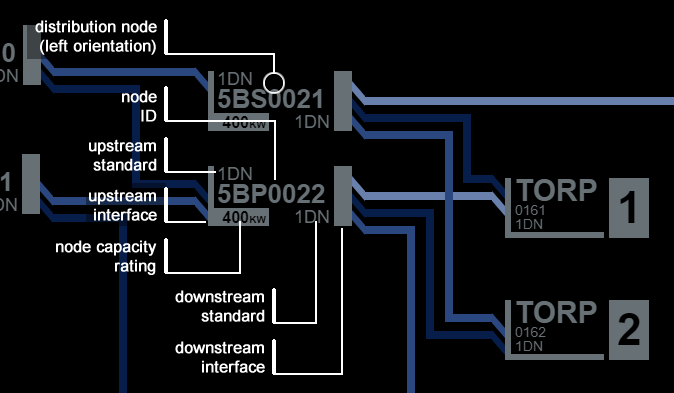
The symbol for a distribution node is a rectangle enclosing data regarding the node’s designation and rating. The narrow vertical line to one side of the symbol represents the node’s upstream interface. The wide vertical line to the other side of the symbol represents the node’s downstream interface.

UPS Nodes

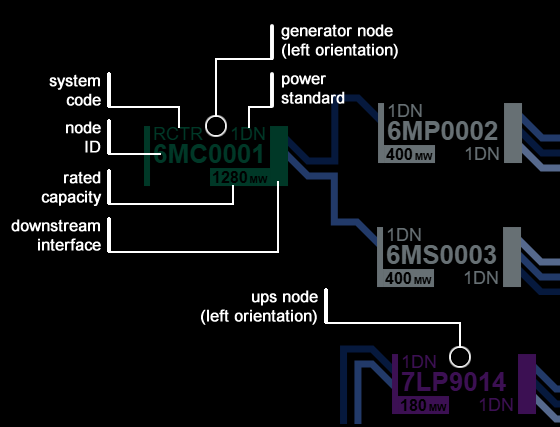
UPS nodes are distribution nodes that also contain battery power storage, to cover temporary outages in power for critical systems. UPS node symbols use the same layout but are coloured green.

Node Symbol Data

Node symbols display data about the configuration of that node.

Upstream Interface Standard: This identifies the power standard the node can receive.

Node ID: This is the node's UID

Rated Capacity: This identifies the node's rated power distribution capacity.

Downstream Interface Standard: This identifies the power standard the node distributes.

PDN Designation

System Nodes

Above: System node overview (click for larger)

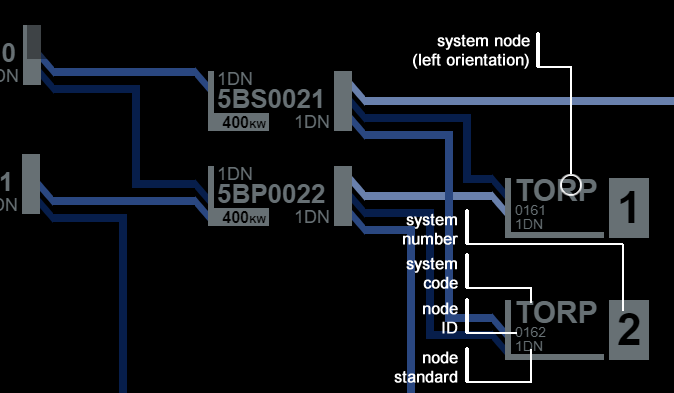
System nodes are the next most common type of node. They are represented by a different symbol to reflect that they only receive power for consumption and so only have an upstream interface. The upstream interface is represented by a narrow vertical line on one side of the symbol.

Node Symbol Data

Node symbols display data about the configuration of that node.

Node Standard: This identifies the power standard the system can receive.

Node ID: This is the node's UID

System Code: This identifies the system represented by the node. Where there are multiple systems of the same type, each system is given an additional number designation.

Generator Nodes

Above: Generator node overview (click for larger)

Generator nodes produce power and so only have a downstream interface. As such, the symbol used for a generator is slightly different from a distribution node and the symbol's colour is purple.

The downstream interface is represented by the wider vertical line on one side of the symbol.

Node Symbol Data

Node symbols display data about the configuration of that node.

Power Standard: This identifies the power standard the node delivers.

Node ID: This is the node's UID

System Code: Generators have system codes to assist with the identification

Rated Capacity: This identifies the node's rated power generation capacity.

Conduits

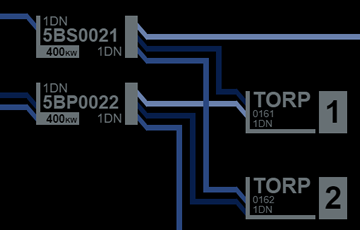
Above: Examples of conduits flowing from distribution nodes (left) to system nodes (right). Note the angled "taps" at each end

Power is delivered between nodes by conduits. A node connects to a conduit via a conduit tap on either its upstream or downstream interface.

The node supplying power to a conduit is the upstream node. The node receiving power from a conduit is the downstream node.

Conduit Symbols

Conduits are represented by coloured horizontal or vertical lines, with a different colour representing each distinct conduit.

Conduits never connect to other conduits, only to nodes. If a conduit crosses another on a schematic, no connection between the two is implied.

A conduit tap (connecting to a node) is represented by an angled line which ‘flows’ in the direction of power delivery. For example, a conduit tap to a node’s upstream interface will always meet the node symbol at a point vertically lower than it meets the connecting conduit.

PDN Designation

The Power Distribution Network (PDN) is made up of a number of nodes located around the vessel. A power distribution node is a junction where multiple conduits meet for the purpose of power distribution. Nodes may also perform conversion between power standards.

Correctly identifying each component node relies on a designation protocol, which includes a seven-character unique identifier (UID) and additional codes to identify the node's supported power standards and power ratings.

The designation protocol is used on control consoles where PDN nodes are monitored and managed.

Node UID

The first three characters of the UID indicates its location on the vessel, in the order DECK-SECTION-PORT/STARBOARD.

For example 5FS indicates the node is located on deck five, section F, on the starboard side.

The remaining four characters are a unique numeric code.

Power Standard

1DN: designates the node as part of the primary distribution network supplying medium voltage (1000V) DC power.

2DH: designates the node as part of the secondary distribution network supplying high-frequency (400Hz) AC power at 440 volts.

2DL: designates the node as part of the secondary distribution network supplying low-frequency (50Hz) AC power at 240 volts.

PDN Nodes

PDN node
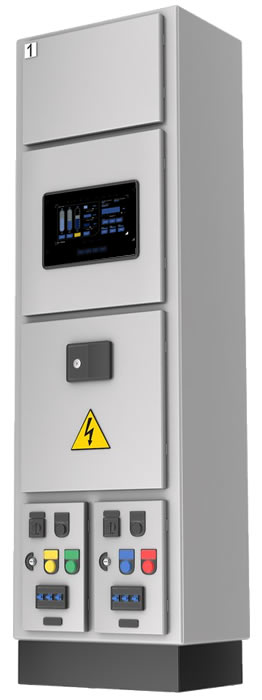
Above: Example of a PDN node

Power distribution nodes are used to route and convert power across the vessel's Power Distribution System (PDN).

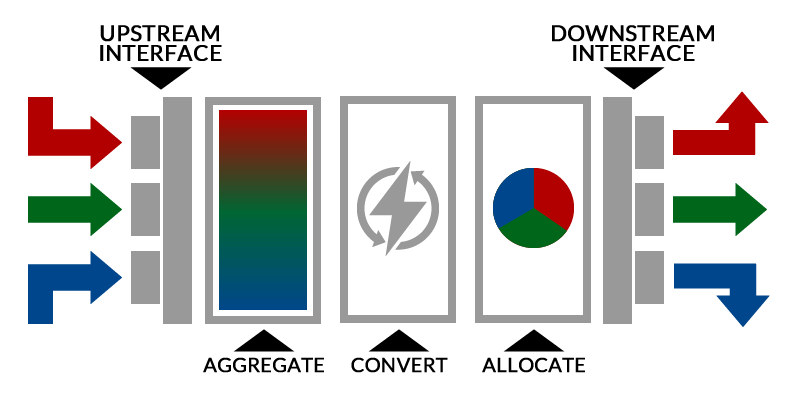
Each node can receive power from up to three sources via its upstream interface. The supplied power is aggregated and made available for allocation to up to three other nodes via its downstream interface.

Power is distributed to and from a node via connected conduits.

Distribution nodes typically have a number of both upstream and downstream conduits to ensure redundant power routing options and for efficient power distribution.

Standards Conversion

A node can convert power standards before distributing to downstream nodes if equipped to do so. This capability is specific to the node's hardware and is not a configurable option.

UPS Nodes

Above: A Node's main functions from power input (left) through to power output (right)

Distribution nodes can be equipped with battery storage to provide Uninterruptible Power Supply (UPS) capability.

More on UPS Nodes

Node Variants

A number of node variants perform specific functions in the PDN.

Supply Nodes

Supply nodes are connected directly to a power generation source such as a reactor or auxiliary power system and so only have a downstream interface (to deliver power).

System Nodes

System nodes are connected directly to a ship system that uses the supplied power and so only have an upstream interface (to receive power).

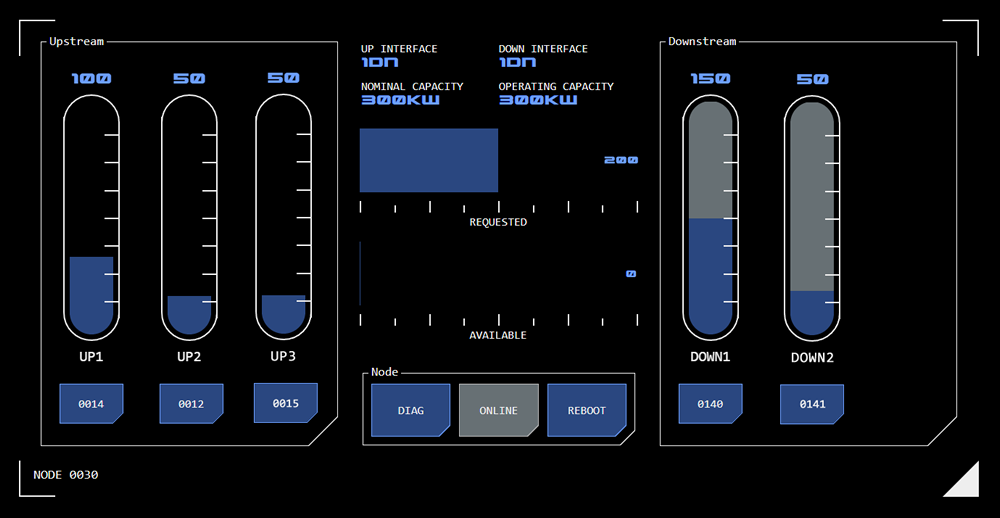
Above: Node control interface example. This distribution node has three upstream nodes and two downstream nodes connected.

In addition to the power connection there is also telemetry connectivity between a system node and the ship system being supplied with power. This enables a system node to monitor and report on the status of the connected system via the node's diagnostic interface.

Control Interface

Each node has a control interface which manages the distribution of power from upstream to downstream interfaces and provides system status and diagnostic information.

The control interface can be launched from a PDN console panel, or from a console that includes a system node using the associated POWER button.

More on Node Control Interface

System Groups

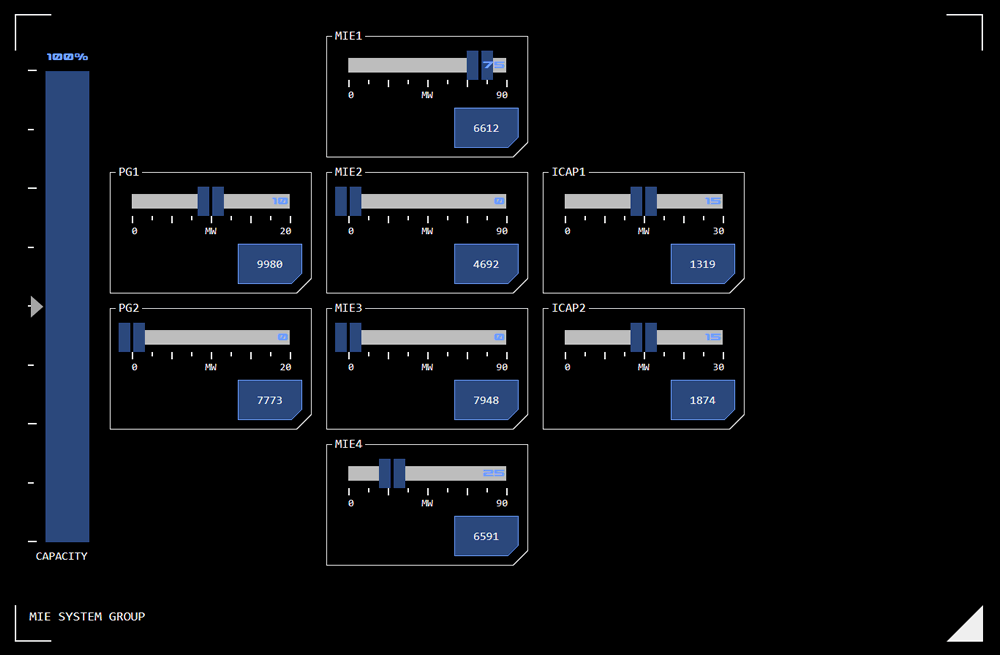
Above: System group monitoring overlay example.

A system group is a functional grouping of system nodes that represent an operating vessel system.

For example the vessel's main MIE engines operate using plasma generators, plasma thrusters and impulse accelerators, each of which are represented by a system node. The MIE system group presents these component systems to assist with rapid diagnosis and configuration.

The monitoring overlay interface for system groups has a significantly different layout to PDN nodes. It can be launched from condition monitors or from a console that includes a system group using the associated SYSTEM button.

More on System groups

Power Distribution Network (PDN)

Image

The vessel’s Power Distribution Network (PDN) is a highly redundant, layered distribution system for delivering power from generation and auxiliary power sources to vessel systems.

The system is made up of a network of electrical conduits which link distribution nodes, creating a web-like network that provides multiple paths between power sources and consuming systems. Power can be routed around the network to meet operating requirements or to bypass damage and is transformed to the voltages and frequencies required by various vessel systems.

The PDN also monitors and reports on the status of the systems connected to it.

Structure

The Power Distribution Network is layered, with the first layer (the primary distribution network) providing maximum distribution capacity between primary generation sources and first-layer distribution nodes. Some high-consumption systems such as propulsion are supplied directly from the primary network.

From the first-layer distribution nodes, a second layer (the secondary distribution network) uses a range of smaller-capacity conduits to deliver power to distribution nodes closer to the systems consuming it.

Distribution Nodes

Distribution nodes receive power from up to three sources via an upstream interface. The supplied power is aggregated and converted to the required distribution standard (voltage and current) which can then be delivered to up to three destinations via a downstream interface.

Each node has a configuration interface that allows power allocation between downstream outputs to be adjusted, which determines how much power the connected downstream nodes receive. 

Some nodes are supply only (such as generators).

More on Nodes

Node Priority

Nodes can accept up to three supply inputs and can output up to three downstream systems.

The three outputs are prioritised, with the first output having the highest priority. If available power drops below what has been allocated, power will be unallocated from the lowest priority output first.

System Nodes

System nodes are vessel systems which only consume power and aren't involved in distribution. Power management for system nodes can be configured from the relevant system's control console.

Conduits

Distribution nodes are connected by conduits. 

The voltage and current that can be handled by each conduit is limited by the physical parameters of the conduit (for example the size of the cable cores making up the conduit, their insulation and shielding, etc).

Conduits typically have significant redundant capacity over that needed for their nominal distribution role to support additional load due to alternative routing of power around damage.

Power Standards

Primary Distribution Network (1DN)

The DC output of the reactor is immediately regulated to medium voltage (1000V) DC. This is distributed via the Primary Distribution Network (1DN), consisting of a relatively small number of high-capacity conduits linking generation systems to layer-one distribution nodes and directly to propulsion systems.

The network includes redundant conduits which are installed along physically different routes throughout the vessel to minimise the effect of damage on the network’s minimum delivery capacity.

Secondary Distribution Network (2DN)

The Secondary Distribution Network (2DN) consists of a large number of lengthy mid-capacity conduits linking distribution nodes with distribution boards supplying vessel systems.

The DC supply from the 1DN is inverted to AC at the distribution node. Depending on the downstream requirement, inversion will be to either high-frequency (400Hz) or low frequency (50Hz) AC.

400Hz Secondary Distribution Network

The high-frequency 400Hz 2DN is an AC system rated at 440 volts.

High-frequency AC (HFAC) power offers advantages over standard frequency AC in a number of applications:

  • Electric equipment can be much smaller and lighter. For example, doubling frequency generally permits electric machines to be 75% smaller. Other grid components (such as transformers, filters and circuit breakers) can also be smaller.
  • Electric motors can achieve higher speeds. High-speed induction motors can be directly used for compressors, high pressure pumps and turbines.
  • Acoustic noise is reduced dramatically due to a higher frequency mechanical vibration.
  • Harmonics in HFAC systems are at a higher frequency and so are more easily removed by filters.

HFAC presents grid safety challenges. Circuit breakers must react faster to overload conditions in high frequency transmission scenarios to prevent damage.

50Hz Secondary Distribution Network

The standard frequency 50Hz 2DN is a three-phase AC system rated at 240 volts. Most supplied systems use a single phase, with the use of individual phases limiting cross-system interference.

Network Management

Each PDN node can be managed remotely from engineering consoles. This includes the ability to reallocate power between upstream sources and downstream nodes, and diagnostic monitoring.

Monitoring

The condition of each node is monitored. Alerts or alarms are displayed on the master systems panel. 

Mapping

The PDN is visualised as a schematic map on a dedicated console configuration, viewable in different sections or from the perspective of each major system. The PDN map provides direct access to the control interface for each node.

PDN Schematics

Systems Telemetry

Each system connected to a PDN node passes telemetry to the node on the system's condition. This allows connected systems to also be monitored on the master systems panel as well as by the master systems indicators on any console managing that system.

Terms of Use

M-Squared Media Pty Ltd (the ISDC) provides these online services (ISDC Network Services) on the following terms. 

By continuing the access the ISDC Network Services you agree to be bound by the terms outlined below and any additional terms (Standing Orders) outlined in the specific service you access. If you do not agree with any of the terms, as updated or amended, do not continue to use these services.

Contribution of Content

You are responsible for all content you contribute to any ISDC Network Services, including text, photos, videos, audio and links (Your Content).

By contributing content to any ISDC Network Service, you grant the ISDC a royalty-free, non-exclusive, perpetual license to use Your Content within the service that it was submitted to and any associated promotional activity across ISDC Network Services or associated third-party social media services.

You confirm you own or have the right to use any copyright material included in Your Content (including music, photos, quotes and excerpts of audio or video), that you have permission of anyone appearing or performing in Your Content and that you are not infringing any person's rights by submitting the content to the ISDC. You also confirm you have, where appropriate, sought the consent of the parent or guardian of any person under the age of 18 who is featured in Your Content.

Please ensure you keep your own copies of Your Content as the ISDC may not archive, store or back-up Your Content nor continue to make Your Content accessible online.

The ISDC will endeavour to provide you with appropriate credit when using your content, though you understand and agree that this may not always be possible.

User Accounts

You may be required to apply for an account (ISDC Account) in order to be able to access and/or contribute to certain ISDC Network Services. The acceptance of an application for an ISDC Account and the creation of an ISDC Account (Your Account) is solely at the discretion of the ISDC.

Any identifying or contact details required (except for your screen name) will only be used in accordance with the ISDC’s Privacy Policy.

Only one account per person is permitted unless prior written permission is granted by the ISDC.

ISDC Accounts may be permitted access to different ISDC Network Services and/or ISDC Content (Level of Access) at the discretion of the ISDC.

ISDC Accounts may be assigned a certain Level of Access in exchange for payment (Paid Access). Which ISDC Network Services and/or ISDC Content can be accessed and the amount and terms of the payment will be specified in an agreement at the time of purchase (Terms of Service).

You may terminate Your Account at any time. However, Your Content may continue to be available online after termination. Any status, loyalty or reward points or credits you have accumulated will be lost on termination. If Your Account includes Paid Access, it will continue to operate until the end of the period specified in the Terms of Service unless you request an immediate termination.

If you breach these Terms of Use the ISDC may at its discretion block or cancel Your Account immediately, including accounts with Paid Access.

Online Communities

While encouraging rigorous debate and the sharing of diverse opinions, the ISDC expects community members to treat each other with respect and courtesy. These standards apply to interaction within all ISDC Network Services including official ISDC accounts established on third-party social media sites.

You understand and agree the ISDC has ultimate editorial control over all of its online services. The ISDC may edit, remove or exercise its discretion not to publish your contribution for legal, editorial or operational reasons including if the ISDC considers it to be:

  • defamatory, or otherwise unlawful or that it violates laws regarding harassment, discrimination, racial vilification, privacy or contempt;
  • intentionally false or misleading;
  • an infringement of intellectual property rights including copyright;
  • abusive, offensive or obscene;
  • inappropriate, off topic, repetitive or vexatious. For example the ISDC reserves the right to reject contributions that have been widely canvassed in the forum. It also reserves the right to reject contributions from participants who seek to dominate the discussion;
  • compromising the privacy of any person or containing inappropriate personal information;
  • seeking to endorse commercial products or services;
  • seeking to directly solicit donations;
  • deliberate provocation of other community members; or
  • impersonating someone else and/or posting on behalf of a suspended member.

If you breach these Terms of Use, the ISDC may block your account or contributions.

When accessing or participating in an ISDC-managed space on a third party platform, such as channels, pages or feeds hosted on an external site, you agree to comply with the terms and conditions specified by that third party platform.

The ISDC recommends you make sure you understand the privacy settings for each platform with which you engage and choose appropriate options to protect your personal details and content shared.

Use of ISDC Content

All intellectual property rights in the content, software and systems owned by or licensed to the ISDC on any ISDC Network Service, including logos, images, names, designs, trademarks and copyright (ISDC Content) are reserved to the ISDC and its licensors.

Such content is provided for your personal, non-commercial use only. Unless specifically noted in the Standing Orders for a particular service, you may not otherwise reproduce, republish, modify, adapt, translate, prepare derivative works from, reverse engineer or disassemble ISDC Content, without obtaining the ISDC’s prior written permission.

You agree not to remove, obscure, or alter any copyright notice or trademark on any content you access and use. 

The ISDC may restrict some ISDC Content to ISDC Account holders with an approved Level of Access. This restricted content is confidential to the ISDC. You may only access this content if Your Account has the required Level of Access. This content is not to be reproduced or made available in any form to anyone who is not an ISDC Account holder with the required Level of Access without the prior written permission of the ISDC.

The ISDC Environment

The ISDC has developed a simulated environment that is intended to provide an immersive interactive experience that is realistic and dramatically compelling (the ISDC Environment). Your participation in ISDC Network Services may be within the context of the ISDC Environment, including playing a fictional character, interacting with other fictional characters, interacting with simulated systems and participating in interactive dramatic plots.

The ISDC Environment incorporates dramatic and editorial devices intended to preserve the realism and dramatic impact of the simulation, including (but not limited to):

  • fictional organisational structures, systems and procedures;
  • fictional scientific principles, procedures and techniques;
  • fictional technical principles, procedures and techniques;
  • fictional characters; and
  • fictional representation of historical events and historical figures

The following Terms of Use are specific to interacting with ISDC Network Services in the context of the ISDC Environment. 

Personas

If you chose to participate you will need to create a fictional persona that represents you within the ISDC Environment (Your Persona).

Your Persona will include a name, a visual representation (Your Avatar) and various fictional biographical and descriptive details. The details you choose to add to Your Persona are considered Your Content and are subject to the same Terms of Use.

You may choose to use your own name for Your Persona or you may make up another name. If you choose another name, it must not impersonate anyone or otherwise be similar to another person’s name and must not infringe someone else’s intellectual property (for example by being similar to a character in a work of fiction).

Your Avatar does not have to be an image of you but you may choose to include an image or artistic representation of yourself. Your Avatar cannot infringe another’s copyright.

You understand and agree that the ISDC retains full editorial control over all of its online services including Personas. The ISDC may at its discretion edit, block or remove a Persona for legal, editorial or operational reasons including if the ISDC considers it to be:

  • defamatory, or otherwise unlawful or that it violates laws regarding harassment, discrimination, racial vilification, privacy or contempt;
  • an infringement of intellectual property rights including copyright;
  • abusive, offensive or obscene;
  • compromising the privacy of any person or containing inappropriate personal information;
  • seeking to endorse commercial products or services;
  • deliberate provocation of other community members; or
  • impersonating someone else 

Only Your Persona will represent you on ISDC Network Services and only the details included in or directly associated with Your Persona will be shared in accordance with the ISDC’s Privacy Policy.

Service Record

Your Persona may be associated with information relevant to your participation with ISDC Network Services (Your Service Record), including:

  • training you may undertake or complete
  • qualifications you may gain
  • status or rank that you may attain
  • postings or missions you may be assigned to

Your Service Record will only include information about your activity on ISDC Network Services and will only be presented in the context of Your Persona. You will be able to review your Service Record at any time. Your Service Record may be shared with other participants within the ISDC environment.

The ISDC will take reasonable steps to ensure that the information included in your Service Record accurately reflects your activities within the ISDC.

You understand and agree that the ISDC retains full editorial control over all of its online services including the awarding of qualifications, status or rank, or assignment to postings, missions, etc.

Contributions to the ISDC Environment

The ISDC encourages participants to contribute to the improvement and enhancement of the systems, procedures and techniques within the ISDC Environment for the benefit of all participants.

You agree and understand that the ISDC retains full editorial control over the ISDC Environment and all of its online services and that any contributions are implemented at the discretion of the ISDC.

If you have a suggestion for an improvement to the ISDC Environment you should submit it in writing via ISDC Network Services such as Forums, Groups or Blogs. By submitting your suggestion (Your Submission), you agree to grant the ISDC a royalty-free, exclusive license to the procedures, techniques, systems, dramatic devices or other intellectual property it contains for the purpose of evaluating your suggestion by other participants and the ISDC.

You understand and agree that you are responsible for the content of Your Submission. You confirm you own or have the right to use any intellectual property included in Your Submission and that you are not infringing any person's rights by submitting it to the ISDC.

You understand that the ISDC may already be working on a concept that is materially similar to Your Submission and that agree that if this is the case, Your Submission will not affect the ISDC’s ability to develop and deploy the concept independently.

The ISDC may at its discretion choose to implement part or all of Your Submission. If accepted for implementation, you agree that the license you granted to the ISDC at submission becomes perpetual for the purpose of including the procedures, techniques, systems, dramatic devices or other intellectual property into the ISDC Environment. If the ISDC chooses not to implement Your Submission, the license you granted to the ISDC on submission will lapse.

If Your Submission is accepted, the ISDC agrees to make reasonable efforts to credit you for Your Submission. Precedence for credit will be based on the time and date of submission to ISDC Network Services. The ISDC may also at its discretion provide other acknowledgement of Your Submission including the award of loyalty or reward points, increase in rank (status) or a new posting.

About the ISDC

Image

The ISDC is a multi-national organisation established by secret international treaty, dedicated to establishing and maintaining a human presence in deep space. The motivation for this initiative and source of the technology that makes it possible derives from recent contact with extra-terrestrial visitors.

Background

The ISDC’s formation resulted from the secret defection to Australia of group of scientists from a US military program. They brought with them technology – much of it recovered from captured alien vessels – that makes the launch of an interstellar vessel possible.

The creation of an alternative program was considered necessary to provide additional strategic options for engaging extra-terrestrial visitors. While the US program emphasises demonstration of force as the means to provide Earth’s security, the ISDC’s founders believe that communication will secure peaceful relations. In their view, aggression risks provoking unnecessary conflict with highly advanced civilisations.

Conflict could not be completely ruled out however, especially when it became apparent that extra-terrestrial visitors may represent more than one species. The increasingly hostile behaviour of their craft suggests at least one species has belligerent intent and may be turning their attention to Earth.

Australia was chosen as the base of operations for an alternative program as it offered appropriate infrastructure, remote but accessible locations and was unlikely to attract suspicion as a close ally of the US. Importantly, Australia's president was a close personal friend of one of the scientists and was instrumental in garnering the international support needed for the creation of the ISDC.

The Organisation

Although the ISDC is a multi-national organisation, the degree of knowledge and official sanction of the ISDC's operation varies by country, depending on local political sensitivities.  Any involvement is highly classified and knowledge of the ISDC is restricted to key ministers and officials.

Personnel are drawn from the military, industry and academia of member nations. The organisation's structure is designed to ensure that these groups are able to work together successfully during both the construction of the interstellar vessel and when it begins operating in deep space.

While not strictly a military organisation, The ISDC's operational activity is governed by a military-style chain of command structure, which provides clear guidance for all personnel on their responsibilities. This clarity is considered vital when operating in unpredictable and potentially dangerous environments expected in deep space.

The Need for Secrecy

Geo-strategic concerns make it necessary for the ISDC's work to remain highly classified. An elaborate network of secret finances and cover-stories has been created to allow the ISDC to pursue its mission and to 'hide in plain sight'.

The Milesham Organisation, an apparently well-endowed philanthropical organisation dedicated to climate change research, is one of the principal covers for the ISDC’s activities.

The need for secrecy is two-fold. Firstly, publicly acknowledging the existence of extra-terrestrial civilizations would incite an unpredictable and likely adverse reaction from the general population and in particular their governments.

Secondly, the US military continues to operate a similar program and the ISDC could therefore be misconstrued as a threat. It is thought likely steps would be taken to destroy the ISDC if its existence became known.

The Mission

The ISDC has a multi-faceted mission in deep (interstellar) space, involving exploration, diplomacy and defence.

The mission's emphasis is on exploration - mapping and documenting stellar and planetary phenomena in the vast reaches of deep space. The focus of efforts will be on areas thought most likely to harbour intelligent life, with a view to initiating first contact with new civilizations.

Once first contact has been made, every effort will be made to establish diplomatic relations, create alliances and gather defensive technology.  Where peaceful relations cannot be established, the ISDC is responsible for defending Earth from extra-terrestrial threats.

Building an Interstellar Vessel

Before the organisation can carry out its primary mission, it must complete development of an interstellar vessel, using scientific knowledge and technology available to the ISDC from a variety of sources.

Construction of the vessel will take place in space under the cover of the ACROSS orbital climate research station, with component modules ferried into space under the guise of extending and supplying the space station.

Endeavour Deck Guide

Endeavour is designed to comfortably accommodate a crew for 3-6 month missions (up to twelve months in an emergency). The ship is equipped to cover multiple mission requirements with labs across various scientific disciplies to allow in-field analysis. During missions the ship is capable of supporting itself without needing to return to base, including performing maintenance and repairs. 

Vessel Design Principles

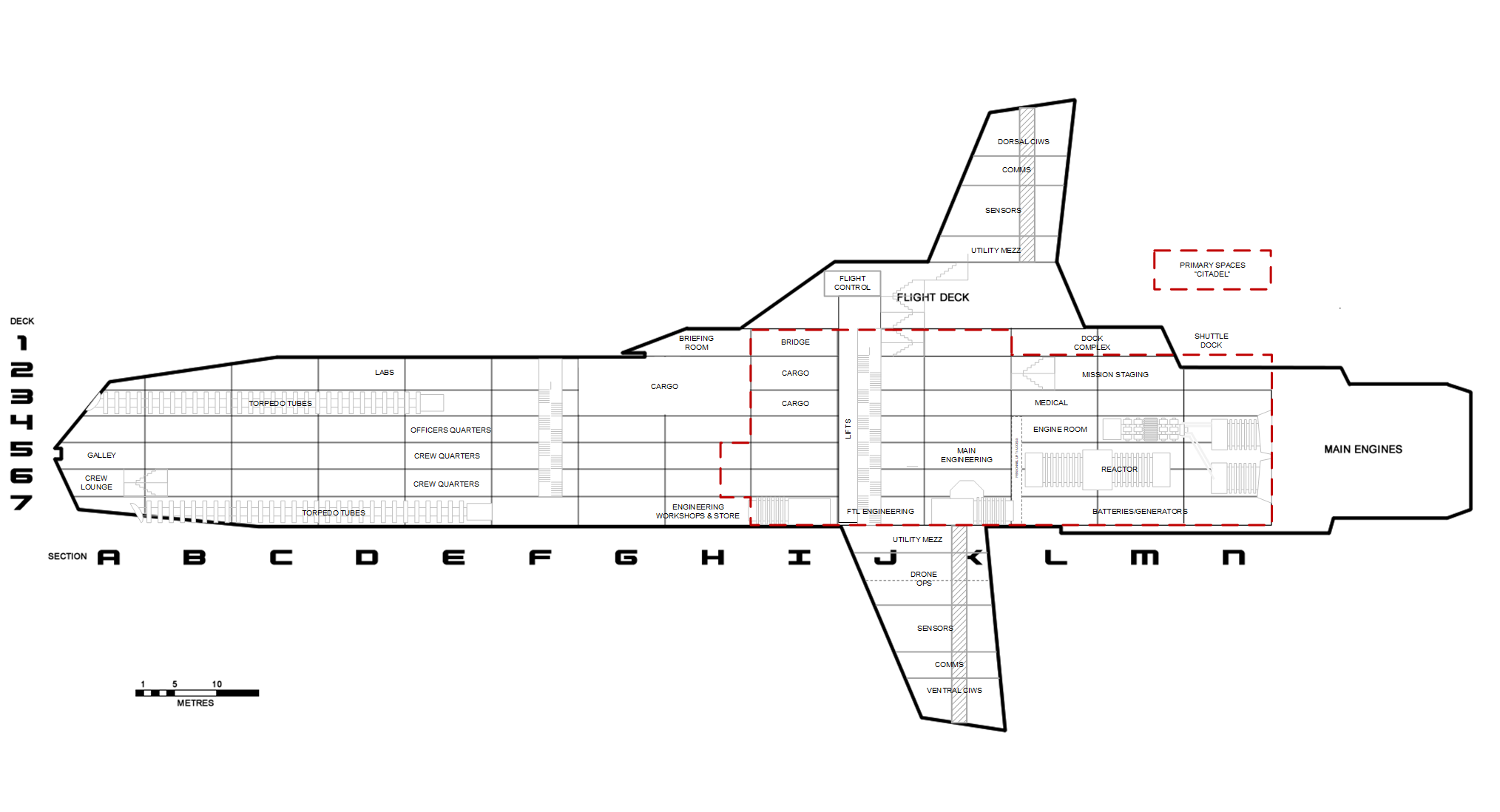
Each deck is self-contained, so that loss of containment on one deck will not impact another deck's operation, apart from shared life support systems (where deck-specific backup systems would operate).

Key Layout Principles

Endeavour's design incorporates three types of internal space to maximise survivability.

Citadel

A heavily armoured central citadel includes internal armour and blast doors separating the citadel from other internal spaces. All critical systems are located within the citadel, which is designed to allow operation and maneuvering even if the rest of the vessel is heavily damaged.

Secondary Spaces

Living quarters, labs, cargo storage and other non-critical spaces take up the bulk of the vessel's volume. These spaces are protected by armour but are designed so that damage to these areas will not be critical to survivability. 

Tertiary Spaces

Forward sections of the vessel are isolated from secondary spaces via an armoured firewall. These spaces typically contain low-priority spaces. Tertiary spaces are designed to take initial impact of incoming fire or damage.

Deck Plan

Endeavour has seven decks and a flight deck.

Deck One

Deck one contains the ship's command centre - the bridge.

The shuttle dock provides direct access to shuttle craft and a decontamination facility for crew returning from away missions.

More

Deck Two

Deck two contains scientific labs, cargo bays and a data centre.

Pre-mission support facilities include a briefing room, crew staging area and armoury, connected directly to the shuttle dock via a dedicated stairwell.

A security office supports the shuttle dock including holding facilities.

More

Deck Three

Deck three contains the vessel's main cargo bays.

The vessel's medical facility, including a medical lab, is located aft.

Two of the vessel's torpedo tubes are located forward on this deck.

More

Deck Four

The vessel's main engine room, providing access to the MIE engines, is located aft.

Officers quarters are located forward. The wardroom is located at the bow.

Sensor equipment, including a dedicated data centre to process sensor readings, is located within the citadel.

More

Deck Five

Crew quarters are located on deck five, along with the galley - the main dining area for crew.

The vessel's main engineering operations and control area is located aft on this deck.

More

Deck Six

Deck six contains additional crew quarters and the crew lounge, which is directly accessible from the galley via a stairwell.

The vessel's fusion reactor and other key engineering systems are accessible from this deck.

More

Deck Seven

Deck seven houses two of the vessel's torpedo tubes and the Faster-Than-Light (FTL) engine.

Engineering workshops on this deck provide for the maintenance, repair and fabrication of a number of vessel components, systems and equipment.

More

Flight Deck

The flight deck launches and retrieves shuttles that are not equipped with a standard docking interface, cargo vessels and larger vessels. A large retractable door aft 

Flight operations for all vessels (including docked shuttles) is managed from the flight control room.

More

Vessel Design Principles

Image

These design principles for ship construction have been issued by the ISDC's Naval Architecture Group. They outline the requirements and objectives that the completed vessel will be expected to fulfill.

The ISDC requires a vessel that is capable of:

  • achieving the superluminal relativistic speeds necessary for interstellar travel;
  • providing an independent scientific exploration and research platform in deep space; and
  • defending itself and the interests of ISDC treaty partners

Architectural Principles

The vessel's mass must be constrained so as to ensure effective performance within the capability of current power generation and propulsion technologies.

The vessel is intended for operation only in space. Capabilities for operation in planetary atmospheric or gravitational conditions or for landing planetside are not required.

The expected design life is fifteen years. It is expected that this will be achieved through a modular design, allowing key systems and habitation spaces fitted to the spaceframe to be swapped out and upgraded throughout the vessel's design life.

Range

In order to maximise the benefit of each mission, it is expected that the vessel will operate in deep space for extended periods of time before returning to Earth.

Operating Range

The vessel must be capable of sustained, independent operation in deep space (operating range) for up to six months, with the capability of operating under emergency conditions for a further six months. This will require consideration of storage capacity for fuel, supplies and spares. Installations and equipment must also have certified reliability (MTBF) ratings appropriate to this range.

Traversal Range

The vessel must be capable of traversing a sufficient number of light years between returns to Earth (traversal range) to make the operating range effective.

This range may be achieved with a combination of fuel storage capacity and the ability to reliably gather fuel while operating.

Environmental

Living conditions aboard ship are considered a major contributor to the success of extended missions in the challenging and isolated environment of deep space. Ensuring the physical and psychological wellbeing of the crew (not all of whom will be from the military) is considered vital for efficient and safe operation. 

The vessel must provide a "shirt-sleeves" operating environment: Earth-normal atmospheric, gravity and background-radiation environmental conditions.

Habitation spaces must not be overly confined or restrictive. The space available for habitation spaces must be balanced with equipment and operating spaces, within the constraints on the vessel's mass and the demands of environmental systems. 

Safety

In the short to medium term the ISDC will have only one vessel capable of interstellar travel which will severely limit the rescue options available should a catastrophic event occur.

The vessel's design must therefore incorporate redundancy and system duplication that is sufficient to ensure the availability of core systems in all but the most catastrophic of scenarios.  The vessel must also have sufficient repair capabilities to ensure that core systems can be restored within timeframes that do not threaten the safety of the crew.

Exploration Functions

The vessel's exploration functions will extend beyond the collection of raw data for delivery back to laboratories on Earth. The vessel will be required to carry a team of scientists and provide them with equipment and laboratories so as to maximise the advantage of proximity to planetary discoveries and stellar phenomenon.

The vessel must function as an independent scientific exploration and research platform, equipped to complete first-level analysis of discoveries (for example from orbit) in sufficient detail to allow more detailed secondary exploration activity (for example planetary landings and surveys).

Data recording and sample collection/storage facilities must be sufficient to allow the capture and retention of all information considered significant enough for further detailed analysis back on Earth.

Defence Functions

The vessel must be capable of effective self-defence in a largely unknown strategic environment. This will require versatility from defence systems.

The primary tactical scenario anticipated will be combat between vessels. It is expected that key tactical drivers in such scenarios will include the ability to avoid detection and maintain distance from threat vessels while maintaining a capability to project force at such distances.

Tactical sensory systems must be capable of identifying and tracking potential threats at the longest possible range while avoiding detection of the vessel itself.

Weapons systems must be capable of delivering tactically decisive payloads to targets at distances consistent with the safety of the ship.

Countermeasure systems must be capable of preventing or minimising damage to the vessel from threat weapon systems. It is anticipated that both kinetic and energy weapons are likely to be encountered - countermeasures to both system types are required.