August 2025

Proximity Grid Module
Above: Proximity grid example with different status displays and the sweep (lower-right)

The Proximity Grid is a multi-purpose module designed to quickly visualise range and direction. The significance of the visualisation will depend on the context of the module’s integration.

The grid can be used purely as a visualistion or it can accept inputs, or both.

The module is typically used to visualise scans, with the scanning vessel at the centre of the grid. 

An example is the Peak Frequency Analysis panel SC-FRQ01.

Check out SC-FRQ01

Layout

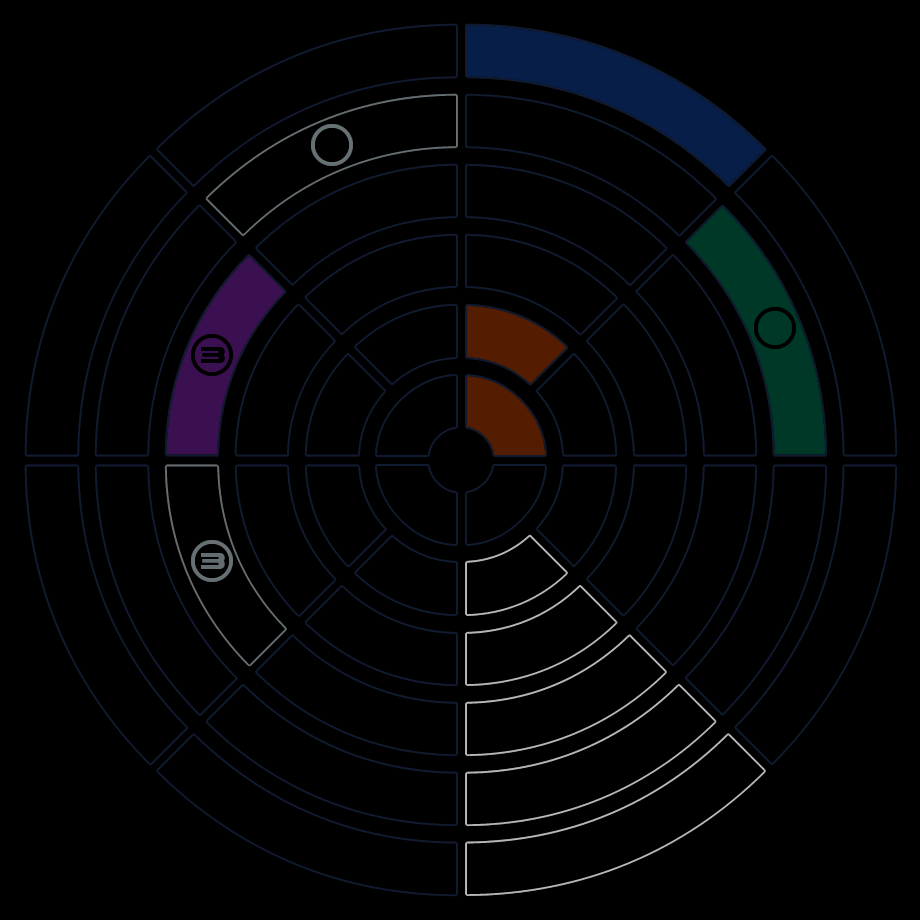
The grid is made up of five concentric rings, each divided into eight radial segments of 45 degrees.

An additional central ring is divided into four segments. This central ring often takes on additional significance depending on context, for example indicating direct contact or a direct hit (as shown by the ochre segments in the example).

A segment of the grid can be tapped to select that point of interest (if input is enabled), or changes to a solid colour to represent a point of interest (which could then be tapped to display additional data, if enabled). 

The core of the grid represents the origin or focus of measurement.

Range

The layers of concentric rings indicate range, starting from the core representing closest range to the outer ring representing furthest range.

Direction

The radial segments indicate approximate direction.

Function

The grid’s display and selection functions (if enabled) have standardised behaviour.

Selection

If a proximity grid allows segments to be selected, this will be indicted by a circle icon which appears in the middle of the segment in any status other than inactive (see below).

A segment must be tapped in its centre (indicated by the circle icon) to select it. 

Status

Segments can indicate different status.

Inactive

A segment’s default state is a grey outline with a black interior. This indicates the segment is not active. 

Above: Pending status examples (lower example shows an assigned segment with pending status)

Pending

Pending status is indicated by the outline of the segment becoming bolder, with the interior of the segment displayed as black except for a grey circle icon in the center.

This acknowledges the segment has been selected pending another action (such as assigning the segment to a monitor so that data or configuration options can be displayed. Once that action has been completed the segment’s status indication will change.

A segment with pending status can be tapped again (before any other action is taken) to cancel the selection.

Active

Above: Active status examples (lower indicates selection is enabled)

Active status is indicated by the segment changing to a solid colour from the Standard Designation Display Protocol (SDDP). If selection has been enabled, a black circle icon appears in the middle of the segment (indicating where to tap).

This status is typically initiated by the data monitor associated with the proximity grid and indicates a point of interest.

If tapped, the segment with change to pending status.

Assigned

Assigned status indicates that the segment has been associated with a data monitor or input panel on the console panel which will display data or configuration options associated with the segment.

Above: Assigned status example

Assigned status adds a number in the centre of the segment which corresponds to the number of the monitor/input panel, but doesn’t otherwise change the current appearance of the segment.

Depending on configuration, tapping an assigned segment may unassign it from the monitor/input panel.

Sweep

A continuous radial sweep can be configured to indicate when the system associated with the grid is operating. The sweep is indicated by an entire radial segment with a lighter outline than the main grid.

The user can usually override the sweep’s settings by making it faster or slower, or disabling it. These settings are accessed by tapping the core of the grid.

Filter

The grid may be configured with user-configurable filters.

Integration

The proximity grid can typically integrated with other display elements such as a selectable list display. This provides somewhere to display point-of-interest data once a segment on the grid has been tapped.
New Website: Tricks & Tips #1

The new website looks much the same as the old one but has been completely rebuilt under the surface. We've carried across as many of the nifty features from the old site as we can and added a few new ones.

The first we'd like to feature is the new table of contents feature for technical document pages. The old website had this but it was awkwardly placed and took up room on the page, especially with a complex article.

The new version of this feature hides itself until it's needed. Tapping the symbol (circled in red in the example) next to the article title opens the table of contents as a dropdown. Tapping an individual link will take you directly to that section in the article.

Once you're done, just tap the symbol again and the table of contents goes away until needed again.

One option we didn't enable was a "back to top" option next to each section header - should we have included that?

Discussion

Escape Pods?

Working out Endeavour's interior deck plan has sparked a debate about the value of an escape pod system, to be used as a last resort.

Technically the concept raises a number of issues. Requiring dozens of apertures in the hull for pod launch would seriously compromise hull - particularly armour - integrity. It's for this reason that (with limited exceptions) there are no plans for even exterior windows on the ship. Grouping pods with a single launch point might be an acceptable compromise between cutting holes in the hull, at the expense of increased evacuation time.

But probably the biggest issue with escape pods is the lack of rescue options. The ISDC will not have another starship capable of reaching a disaster area, severely delaying any rescue response even if one could be mounted. This would likely be beyond the survival capacity of a life pod (level 2 environmental containment), unless they were made prohibitively large. So unless the escape pods are able to make it to the surface of a conveniently located habitable planet, an escape pod would simply delay the inevitable. 

The approach currently being considered is to equip crew accommodation as emergency shelter with independent life-support capability (level 3 environmental containment). The pod architecture of accommodation design lends itself well to this approach and survival capacity would be significantly longer than with a pod. Although this assumes the damage to the ship is not catastrophic.

What do you think?

Discussion

Impulse Mapping Module

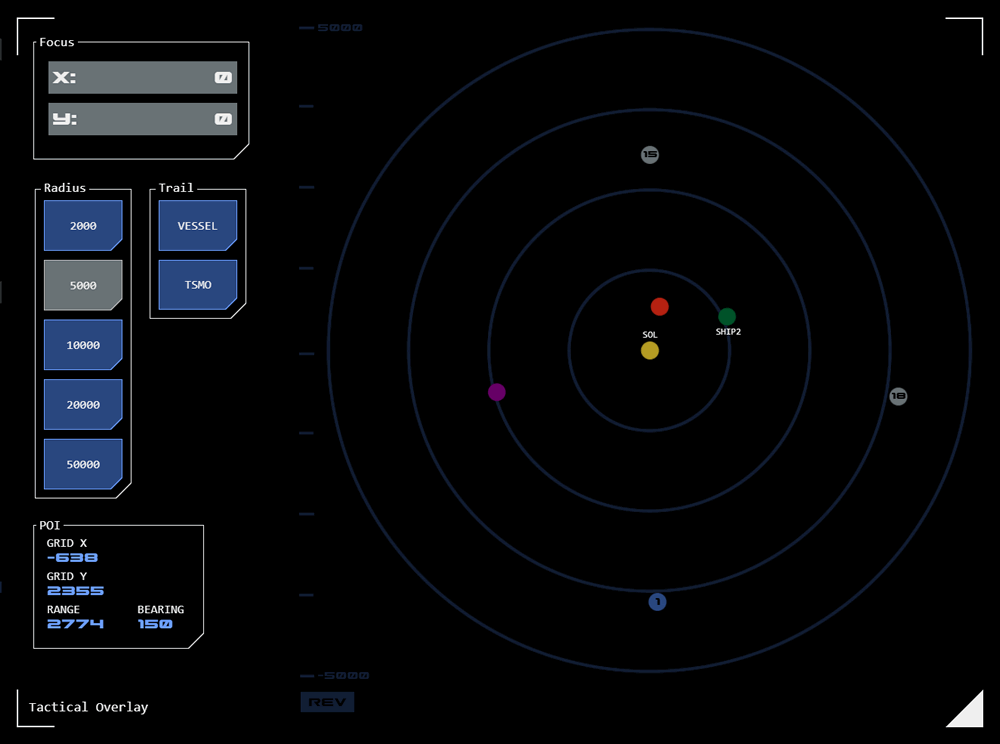
Above: Impulse map example. Note the POI display in the bottom-left corner.

The impulse mapping module provides a 2D overview of the position of relevant objects relative to a chosen focal point.

The module has two modes, One is tactical-focused, the other is navigation-focused.

Common Features

In either mode, common functionality is available.

AO Display

Stars are represented as yellow dots with the designation displayed below. Planets are shown as blue dots with their system number in the centre.

Scale & Focus

Using the buttons at centre-left, the map's scale can be changed by selecting a new range (which describes the distance from the centre of the overlay along the X and Y axes of the TOE grid). The selected scale is displayed at the top and bottom of the left-hand graticule.

The focus (or centre) of the map can also be changed to whatever X and Y co-ordinates the user enters using the dialogue at the top-left.

Tapping the currently selected range button will refocus (center) the grid on the vessel's current position.

Point of Interest (POI)

A point of interest (POI) can be added by tapping the map at the desired location. A purple dot will appear and a dialogue will be displayed at the bottom-left of the module (see map example above), displaying the grid coordinates of the POI and the range and bearing from the user’s vessel to the POI. Tapping the purple dot clears the POI.

Overlay Grid Orientation

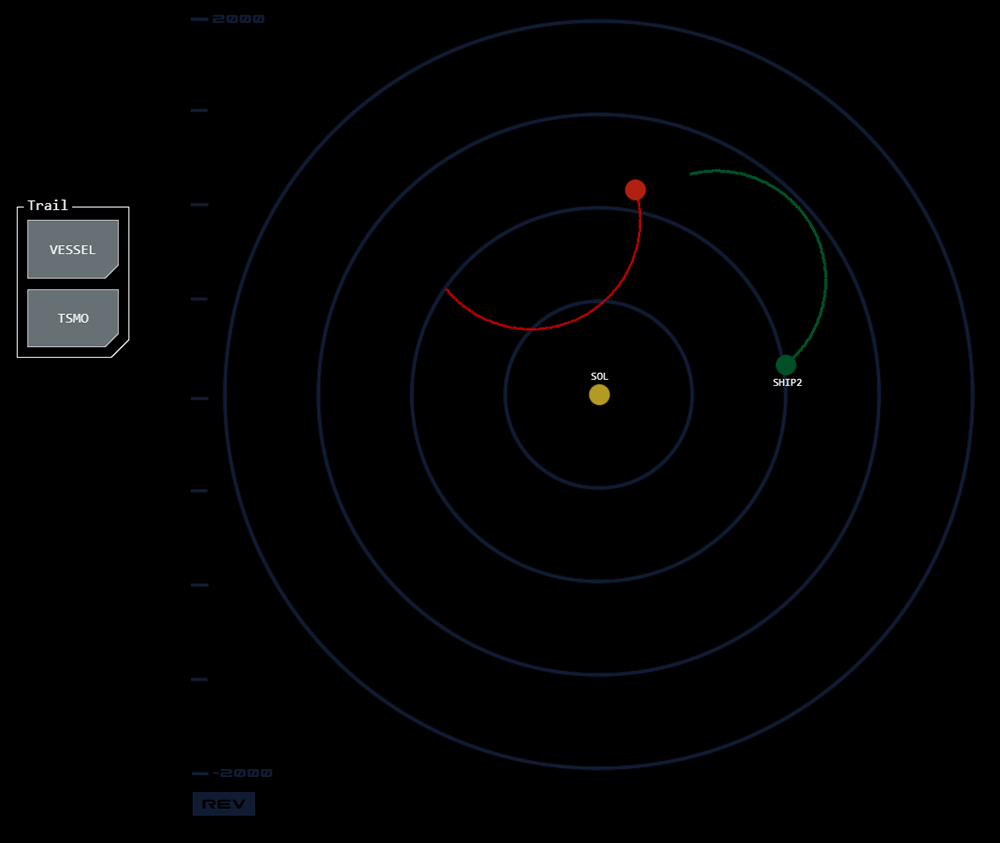
Above: Course trail example showing vessel and TSMO trails (other controls that would usually be visible have been hidden for clarity)

As with the Impulse Navigation AO Map, the X and Y axes can be flipped to present the overlay in a more intuitive orientation. When active, this “reverse mode” is indicated by a REV symbol in the top-right of the overlay.

Tapping the symbol will toggle between reverse and standard (STD) grid orientations.

Course Trail

Optionally a course trail showing the vessel's course over the previous 300 maneuvering cycles can be displayed.

Tapping the VESSEL button will toggle the trail for the operator's vessel on or off.

If in tactical mode (see below) tapping the TSMO button will toggle trails for all TSMOs on or off.

The course trail will reset whenever the map is adjusted (eg scale or focus is changed).

Markup

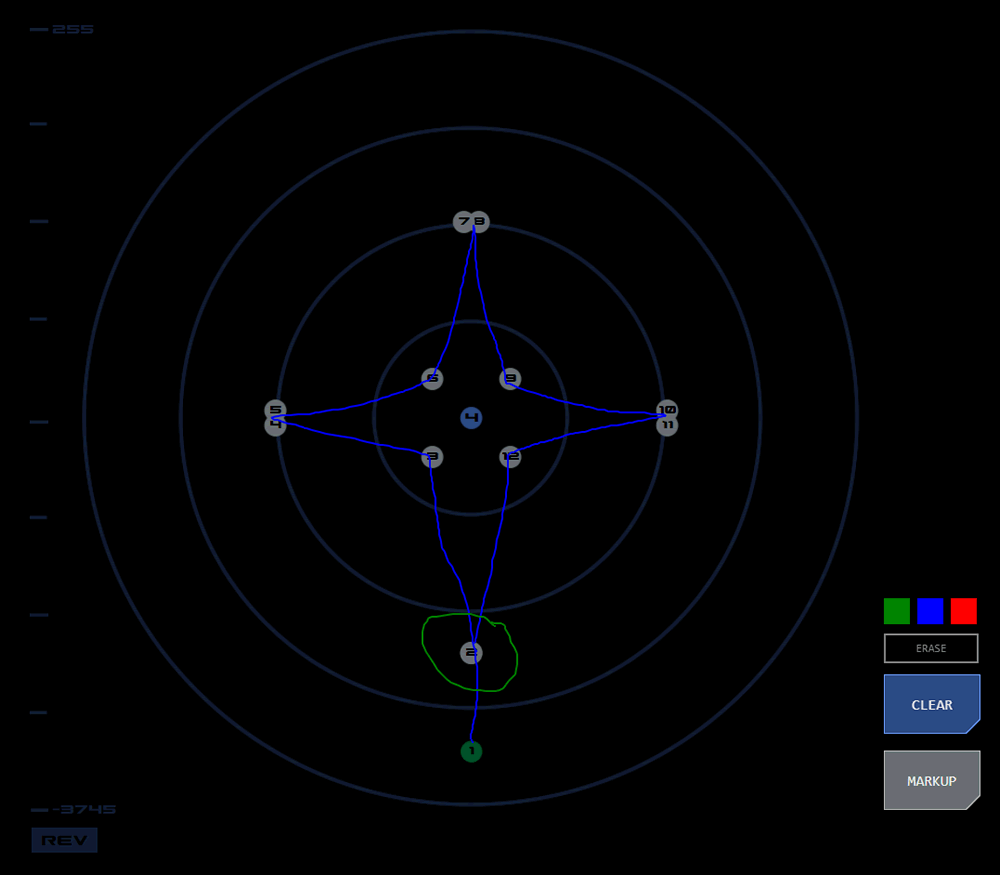
Above: Markup example (other controls that would usually be visible have been hidden for clarity)

The module supports markup functionality. If supported by the panel, a markup button (usually but not always below the overlay launch button) will display in ready mode. When the overlay is open, tapping the markup button will display the markup tool dialog. By selecting a colour (default is red), the user can add markup to the overlay using their finger (assuming a touch panel) or mouse, to visualise possible patterns between contacts, project courses, etc. 

In tactical mode (see below) six markup colours are offered, corresponding to the colours of the vessel, tracked contacts and each of the four contact designations.

Tapping clear will erase all markup. Alternatively, the overlay can be hidden (but not cleared) by toggling the markup button.

Markup controls may appear in different locations depending on where the mapping module is deployed,

Tactical Mode (Mode 0)

In this mode the module is an extension of the contact board module providing a 2D overview of the Tactical Operating Environment (TOE).

It is presented as a console overlay. The overlay is closed by tapping the bottom-right triangular frame button.

It displays all contacts on the board as a hollow dot with the designation number in the centre. The colour of the dot corresponds to the contact's designation:

  • Sierra: SIlver (grey)
  • Bravo: Blue
  • Victor: Violet (purple)
  • Tango: Tan (gold/yellow)

Tracked contacts are displayed as green dots with their database designation displayed below.

The user’s vessel is displayed as a red dot. In this mode the map is centred on the vessel when opened, but remains fixed on this opening position unless adjusted by the user.

Torpedoes fired by the vessel are shown as red hollow dots with the torpedo's ID number in the centre.

Navigation Mode (Mode 1)

In this mode, the module operates in conjunction with a list of co-ordinates (course points) such as a course plotted by a navigator. In this mode the module is integrated into the console.

The focus and range selection panels are displayed to the right of the module.

Course points are displayed on the map as a silver dot with its order number displayed in the middle. One of the course points may be highlighted in green (to show which is currently being navigated, for example).

The modules scale (radius) and focus can be automatically updated with presets when a new co-ordinate list is loaded. The updated focus values will be displayed in the dialog and can be manually overridden by the user.

If the preset scale matches one of the radius button values the appropriate button will be set to active. If the preset scale is a custom value, no radius button will be set to active. In either case, the radius can be manually overridden by the user.

Endeavour's Mission

Image

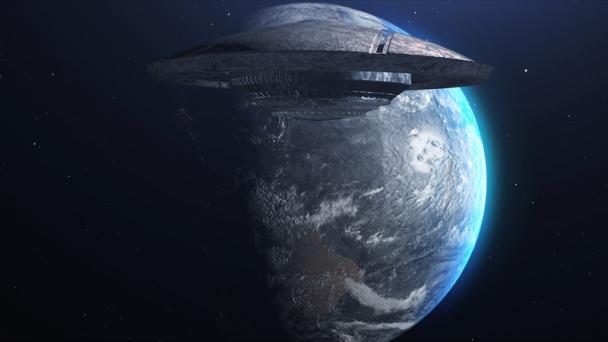
Everyone is familiar with stories of mysterious lights in the sky, thought by many to be visitors from beyond Earth. It turns out they’re right.

Endeavour’s deep space mission has its beginnings in the mid-twentieth century, where ill-fated first contact with extra-terrestrial visitors resulted in their vessels being shot down, captured or crashing. The resulting treasure trove of technology has been picked over by engineers and scientists ever since.

Extra Terrestrial Visitors

Their work has evolved key technologies that will make possible the exploration of star systems by humanity. Multiple engineering programs independently aim to construct and launch vessels to make deep space exploration a reality. 

The ISDC

The International Strategic Deep-space Command (ISDC) is one such program, operating in complete secrecy to construct and launch Endeavour, a starship combining exploration and research capabilities with defensive power.

About the ISDC

Endeavour’s deep space mission will have multiple aspects.

Exploration

Very little is known about the origins of our extra terrestrial visitors, although it is thought multiple civilisations have been encountered so far.

While the ability to reach new star systems and explore new planets, Endeavour’s deep space mission is not purely to satisfy scientific curiosity. Initial research cruises will prioritise discovering the location of advanced alien civilisations.

Exploration

First Contact

Once a civilisation is found, a critical mission objective is to make contact and establish dialogue, with the aim of securing alliances for protection and advanced technology. This is seen as vital to preventing a potential war that the human race may be ill-equipped to fight.

Communication and managing vast cultural differences will be key challenges, with expert exolinguistic and exoanthropology teams aboard to help ensure successful first contact.

First Contact

Defence

It remains unclear what response Endeavour’s presence in deep space will provoke, either from alien civilisations encountered or rival Earth-based programs. The ship will be equipped with weapons and defence systems for protection should diplomacy fail.

Of the technology recovered from alien vessels so far very little has been weapons-based, raising important questions about what to expect if combat is engaged.

Defence

Extra-Terrestrial Visitors

Image

Reports of extra-terrestrial visits to Earth have been documented as far back as 1088, when Chinese official Shen Kuo recorded eyewitness accounts of a "a flying object with opening doors [that] would shine a blinding light from its interior". Such reports became more frequent and detailed from the mid-1940’s although these have typically been classified by authorities, their authors discredited and cover-stories issued in order to prevent public panic.

In fact, many of these reports are true.

Experts have speculated on the cause of an apparent increase in extra-terrestrial activity since World War II. Some suggest that there is no real increase, just an improvement in our ability to detect the visitors. Others have speculated that additional activity may have been triggered by extra-terrestrial interest in the first atomic tests of the period.

Roswell

A pivotal event in Earth’s contact with the visitors occurred in 1947 when an alien craft crashed near New Mexico in the United States. Given the proximity of the crash to a nearby atomic weapon test, some experts believe the EM pulse from the test blast was responsible. The US Air Force quickly took over the recovery operation from local officials, ultimately spawning a research program intended replicate the advanced technology contained in the wreckage.

Other vessels have been recovered around the world, usually after being brought down by military aircraft. The craft have various configurations and sizes, which were initially thought to represent different mission roles such as scouts and larger transport craft. However, when compared it became obvious that they were of different origins, based on significant differences in materials and technology configuration. While it has been extremely rare to recover identifiable remains of occupants, the ISDC believes that the extra-terrestrial visitors represent at least two distinct races or species.

Response Options

Extra-terrestrial visits continue to be reported, although the behaviour of the visiting craft has begun to change and is characterised by tactical experts as more “aggressive”. Visiting craft appear to be adopting more confrontational posture in flight and have become much better at avoiding weapons fire. Most recently, forms of electro-magnetic discharges from craft have been detected, with opinion divided as to whether they are a form of weaponry (due to their effect on avionics systems) or an attempt at communication.

What constitutes an appropriate response to these visits has been fiercely debated. Defence hawks and many in the military see the visits as clear threats to Earth’s security, to which the only valid response is to demonstrate an ability to defend ourselves with force. Others see the visits as peaceful attempts at communication, complicated by the vast differences in technology and language between our species. They insist we should be focussing on improving our ability to reach out to the visitors.

US Airforce Program

The US Air Force program that arose from the New Mexico incident eventually developed sufficient technology to make interstellar travel a real possibility. Initially that program favoured the latter approach of exploration and communication. Senior military leaders and political hawks eventually took control of the program and the vessel’s design and construction is now focussed on the creation of a weapons platform capable of interstellar force projection.

Creation of the ISDC

It was this shift in policy that led to the creation of the ISDC. Many of the leading scientists on the US program became so concerned at the new emphasis on aggression that they defected and sought to form an alternative program to counter the military. Their principal fear is that adopting an aggressive stance with an otherwise peaceful but highly advanced civilisation risks provoking a confrontation Earth cannot survive.

The aim of the new program is the construction of an interstellar platform capable of presenting an alternative point of contact with the visitors, in the hope that establishing communication will lead to peaceful relations and overcome previous misunderstandings.

About the ISDC

Defence

Image

The ISDC is committed to deep space exploration and peaceful co-existence with any extra-terrestrial civilisations encountered, but also recognises the need for defence. It is not known how many civilisations may be encountered that are capable of space travel and hostilities may be unavoidable, particularly given potential difficulties with communication and translation.

While not conceived as a warship, the vessel will be designed with defensive capabilities that allow safe operation in the unpredictable environment of deep space. This will include both active defence systems such as torpedoes and passive defence measures such as hull armour.

Limited contact with extra-terrestrial vessels experienced so far has not uncovered any useful information on their weapons systems. This has led the ISDC to mandate a ‘broad-spectrum’ approach to the defence technology it will deploy, encompassing projectile, directed-energy and electronic-warfare systems.

"The vessels we've seen so far don't appear to have much at all in the way of weapons systems," says Master Chief Alex Peterson, one of the ISDC's senior tactical specialists. "This could be because we simply can't recognise an alien weapons system, or that the vessels visiting Earth so far are just smaller, unarmed scout ships."

The type of weapons system encountered will infuence tactical approach. Directed energy systems are thought to be most effective at closer range, encouraging a 'dogfight" style of engagement. Alternatvely, high-speed guided projectile systems (like the torpedos planned for deployment on the ISDC's vessel) encourage longer-range engagements, which rely more heavily on the skills of weapons direction and tactical sensor crews.

"We'll be simulating a lot of tactical scenarios during training," says Peterson. "We want crews to be ready for whatever gets thrown at them out there."

More on Combat

Terrestrial Threat

Extra-terrestrial threats are not the ISDC’s only concern. The US Air Force currently believes it has a monopoly on deep-space capability and it is thought likely their leadership will react unfavourably should they discover the existence of the ISDC – which is almost inevitable when the vessel launches. The ability to defend the terrestrial interests of participating governments is therefore a required capability for the vessel.

First Contact

Image

The ISDC is aware that we share the galaxy with one or more advanced alien civilisations, although contact to date has been limited to tactical engagements with often unfortunate outcomes. Much of the advanced technology that will be used to reach deep space has been recovered from encounters like these.

A key mission objective for the ISDC is to make first contact with these civilisations and establish diplomatic relations. This is seen as vital to preventing a potential war that the human race may be ill-equipped to fight, although little is known about the motivation behind recent visits to Earth and even less about the visitors themselves.

To date there has been no direct contact with any extra-terrestrial visitors. A number of corpses have been recovered which has driven speculation that there may be more than one extra-terrestrial race visiting Earth, although as the ISDC’s lead exo-biologist Dr Daffyd Jones admits, “any physiological differences may simply be the result of gender. We just don’t know enough about them at this stage.”

As to why the visitors have come to Earth, analysis of recovered vessels has failed to detect any form of weapons system. This suggests the visitors are not inherently hostile but simply curious. Alternatively, it may mean such systems are simply too advanced to be recognised, or that the vessels are shuttles or scouts and so not equipped with weapons.

The governments behind the ISDC are not yet prepared to assume the worst, however.

Diplomacy

The drive for diplomacy is one of the major differences with the rival program run by the US Air Force and is why the ISDC was established.

A group of senior scientists and strategists from the US deep space program had become alarmed at the extent of militarisation within that program, fearing it would likely provoke a war that humanity could not win. With no international co-operation, the group also felt it ethically problematic that the rest of the world would only learn of the situation when war broke out.

Concerned that too little was being learnt about the extra-terrestrial visitors to justify the US ‘defence-first’ policy, a subsection of the group staged a dramatic defection in co-operation with sympathetic elements within the Australian government and military, staging their own deaths in a plane crash and relocating in secret to Australia. Even now the US Air Force continues to think the missing scientists are dead.

Communication

A major challenge to making first contact will be finding a way to communicate. Even assuming that the visitors use verbal modes of communication, it is highly likely their language will be fundamentally different to anything heard on Earth.

“We need to create an understanding of language at a much higher level of abstraction than needed for simply translating between terrestrial languages,” says exo-linguistics specialist Dr John Smith.

“We’re searching for the fundamental building blocks of language – the ones needed for any form of complex communication, even non-verbal. But using that to deliver translations in the field under these kinds of circumstances is… well, it’s mind-blowing.”

Exploration

Image

A key aspect of the ISDC’s mission is deep space exploration. The ability to explore stellar systems and phenomenon at close range is expected to provide unparalleled insights into our universe in a way that long-range telescopy cannot.

The technology being harnessed by the ISDC with the construction of Earth’s first deep space vessel will make extensive exploration within our galaxy possible. Scientists will be able to visit stars and orbit the planets thought to be contained within them, gaining valuable first-hand data where only theoretical conjecture was previously possible.

The ISDC’s leading astronomers, astrophysicists and planetary-science experts speculate that a host of new phenomena not even visible from Earth will be discovered, potentially re-writing scientific texts for years to come. To achieve this, the ISDC’s vessel will be designed as a scientific platform, replete with sensors and instruments that will allow near-range, orbital and even planet-side analysis possible.

Strange New Worlds

Recent evidence suggests that there are far more potentially habitable planets in the galaxy than previously thought, opening up the possibility of making contact with other sentient races.

“Even without the chance of meeting new civilisations, the ability to explore different planetary systems as closely as we can Earth will be of mind-blowing significance,” says Dr Leandro Hogan, a geophysics specialist within the ISDC’s Planetary Science division.

“I can’t tell you how exciting it will be to see data come through the sensors from our first orbital scans outside the solar system. For a scientist it’s a once in a lifetime opportunity.”

The vessel will have the capability of sending exploration teams to the surface of suitable planets, although whether any will be found remains uncertain.

“Given the sheer number of star systems that will now be in reach, I’m confident we’ll find them,” says Hogan.

“The trick will be figuring out where’s best to look first.”

Getting There... and Back

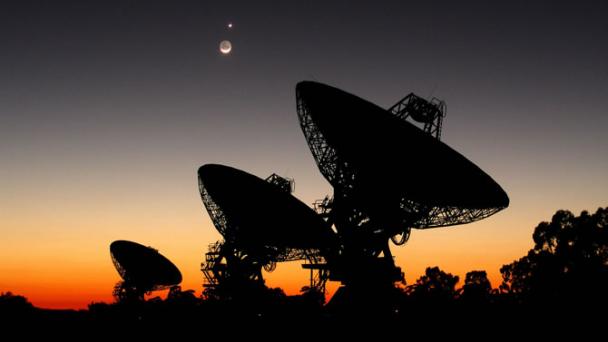
Currently the ISDC is making clandestine use of major telescope arrays around the world to create stellar ‘maps’ that will assist with navigation once the vessel is outside the familiar confines of our solar system. The ability to pinpoint the vessel’s location from vastly different areas of the galaxy will be vital to the success of the mission.

“Traditional, long-range astronomy will still have a role,” according to Dr Zoe Lindquist, an astronomy specialist working on the ISDC’s stellar cartography project.

“Knowing how to get where you’re going next – or even how to get home – needs new techniques and approaches to astronomical navigation that we’ve never really seen before.”

Collaboration & Discussion

Image

A key part of your experience with the ISDC will be sharing ideas, news and views with your crewmates. The site offers a number of features to facilitate this.

Groups

Groups are social media style collaboration spaces that allow members with similar interests or working in the area to share updates, exchange insights and debate ideas. The available groups can be viewed under the COLLAB menu option.

If you see a group that interests you, click the JOIN GROUP link at the top right of the group screen (under GROUP ACTIONS).

Once you’re a member of a group, you can add your own posts, which could take the form of a question, a link to an interesting article, or an update on something you’re working on that you need feedback for.

You can also comment on other posts (see below).

Updates

When a new post is added to a group that you’re subscribed to, you’ll get an email notification.

Mission Group

The Mission Group is for general discussions about life in the ISDC, mission news and updates about the organisation. All members automatically become members of the Mission Group.

Discussions

Commenting on blogs or group posts is a great way to start or participate in a discussion. Comments take the form of a threaded discussion under the original blog or post.

Whenever a new comment is added to a blog or post, a gold dot is displayed on the author's avatar. Within the blog or post, the summary header displays the number of comments and how many new comments are available. A gold dot is displayed on the author's avatar of new (unread) comments. 

Teams

Crew teams allow members with complementary skills and interests to form crews for simulation missions, with each crew member taking a simulator post based on their training and qualifications.

Depending on the scenario’s requirements a simulation crew might need rated specialists across helm, tactical, operations, engineering and science systems, so a team with a good mix of ratings will have a greater choice of mission scenarios.

If you already have a group of interested friends you can create your own team, or you can browse existing teams to find one you’d like to join.